Electric Vehicle Charging at Work

Electric Vehicle Charging at Work

Leading the charge for your employees and customers

As more drivers transition to electric vehicles and EV sales continue to rise, businesses are increasingly providing workplace EV charging to support staff, customers and visitors. Workplaces are many and varied of course, but there are a whole host of benefits that come with offering EV charging. Here are just a few: 

  • Increasing footfall: EV chargers can attract clients and customers and also increase their time spent with you.
  • Attracting and retaining staff: EV charging is a tangible benefit, appealing to eco-conscious employees and staff who are increasingly driving electric.
  • Generating revenue: Whilst you can opt to offer complimentary charging, businesses can charge employees or visitors for electricity usage, creating a consistent revenue stream.
  • Enhancing sustainability credentials and brand Image: Offering EV charging demonstrates a real commitment to reducing CO2, strengthening brand reputation when it comes to sustainability.
  • Future-proofing your Infrastructure: Installing charge points means being prepared for the ongoing growth of electric vehicles and the phasing out of internal combustion engines.
  • Cost savings and tax benefits: Eligible UK businesses can reduce installation costs by up to 75% (£500 per socket) via the Workplace Charging Scheme. Workplace charging can also be exempt from some income tax and national insurance contributions.


Grants for business EV chargers

Grants are available for installing EV chargers at work. From April 2026, grants of £500 per socket will be available, up to a maximum of 40 sockets. Currently the grant level is £350. For more details see our Grants for Electric Vehicle Charging Page.

A word on Dynamic Load Balancing

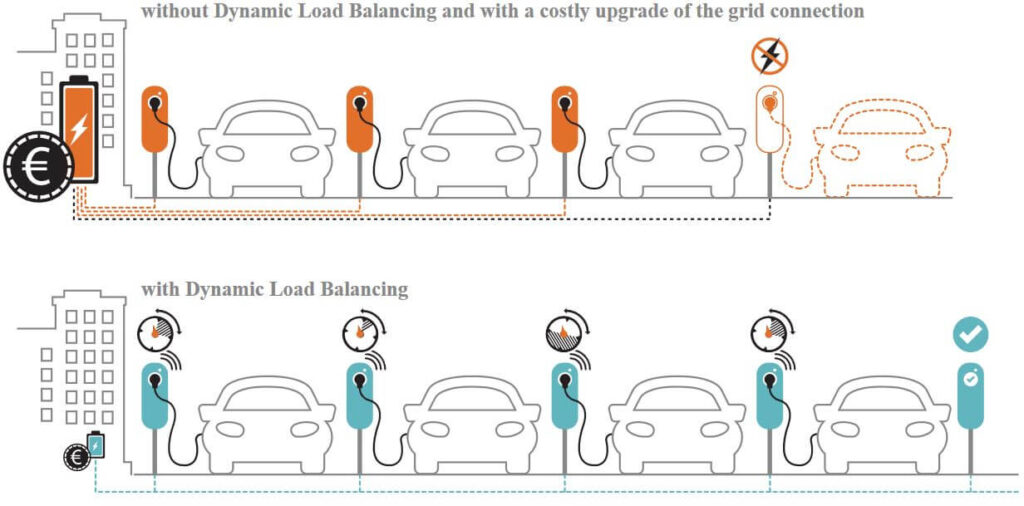
Many EV installations in the workplace require multiple charge points. If all were being used simultaneously this could require an oversized, over-engineered solution, or otherwise risk overloading the electrics. However, we can look at smart charging solutions featuring dynamic load balancing, smartly allocating available power between the units.

For example, we can set 6 units to charge at a maximum of 22kW. If only one workplace EV charging station is being used, it will receive the full 22kW. If three are being used, this drops to 7.2kW each, and if all 6 are being used, each vehicle receives 3.6kW. Overall it means you can run 6 charging points off of a 22kW supply, instead of something larger and more expensive.

This is because the required infrastructure (wiring, distribution boards, required import capacity) can be kept at more sensible sizes and minimise the cost of the installation. If your electric car parking bays aren’t going to be used at full capacity all the time (as cars come and go), this is an optimal approach to take. We’ll always take your unique workplace circumstances into account to ensure you always have the right charger in the right place. 

DynamicLoad

Using chargecards


It’s also possible to set up billing on each EV charger, where users pay to charge their vehicles. Rates can be set by the owner, and the units are accessed by a standard RFID charge card. All charge point usage and billing data is controlled by a centralised web portal for easy access by finance departments.

Billing home charging

For businesses running fleets or paying staff travel expenses, it’s possible to connect a smart charger, at home, to the billing system of the business. That way, fuel costs can be reimbursed automatically.

Start your project

We’d love to help you install EV charge points at your workplace. Just contact us to get the ball rolling and you’ll soon be charging ahead, with our support!