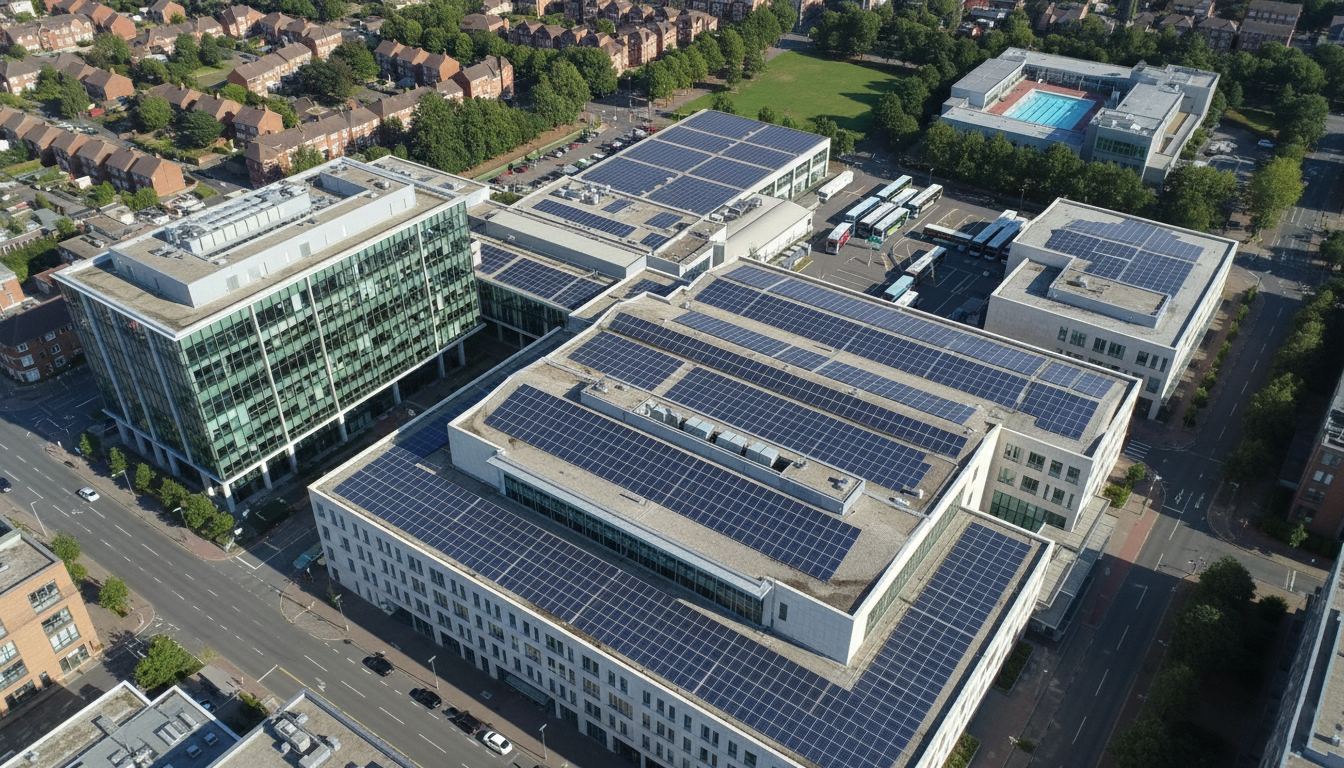
If you’re considering solar for your business, our Joju Solar team is on hand to offer advice on your investment, and to share incentives available for incorporating solar power.
Of all the possible funding routes – funding your solar PV investment with your own capital will generate the highest financial returns for your organisation. However, there are other options:
At Joju, we offer a Power Purchase Agreement (PPA) funding model, with both community- funded and privately funded options, in collaboration with our trusted partners. In this case, there would be no upfront costs for the owner of the building the solar is to be installed on.
If you, or your business, owns a site and wants to enter into a PPA contract, you lease your space (typically a rooftop) to the solar developer. The site will only pay the developer, (who installs and maintains the solar PV system for the agreed term), a competitive pre-agreed electricity price for using the solar generated electricity during the contract length.
Power purchase agreements are usually offered for 10-25 years, after which the ownership of the system will be transferred to the site.
Joju can also facilitate access to lenders, who offer financing for solar PV systems, through Hire Purchase or Finance Lease arrangements. The site is then responsible for the operation and maintenance of the solar PV system.
To talk through the options in more detail with our team, contact us and we’ll be very happy to help.

There are are number of tax benefits for businesses installing solar panels.
Annual Investment Allowance (AIA):
When it comes to capital expenditure, businesses can deduct 100% of the cost of qualifying plant and machinery, including a solar photovoltaic (PV) system, from their taxable profits in the year of purchase. The AIA allows for up to £1 million in qualifying expenditures annually.
50% First-Year Allowance (FYA):
If any business has used up their Annual Investment Allowance (AIA), they can deduct 50% of the value of a new solar photovoltaic (PV) system from their profits in the first year (available until 31 March 2026). The remaining 50% is at 6% in subsequent years.
Benefit explained:
The tax savings can reduce your overall project cost by 19% (if you are a smaller company with profits under £250,000) or 25%.
“The construction process was well planned and safely executed and the installations were completed within budget and to exacting timescales”
Metropolitan Police Training Centre
The UK government periodically offers grants, loans and other forms of financial and advisory support to help businesses implement energy efficiency measures. For the latest information, just head here.
This scheme allows businesses to sell surplus electricity generated by their solar, back to the National Grid, obliging utilities to buy the power. Typically, export payments range between 5-7p/kWh.
Capital allowances on solar panels are tax deductions that businesses can claim on the cost of installing solar panels in commercial properties. The UK government offers tax relief in the form of capital allowances to encourage businesses to invest in renewable energy and reduce their carbon footprint.
Under the current rules, businesses can claim a 100% first-year capital allowance on the cost of purchasing and installing solar panels, meaning that the entire cost of the investment can be deducted from taxable profits in the first year. This can provide a significant financial incentive for businesses to invest in renewable energy and can help to reduce the payback period for the investment.
In order to be eligible for capital allowances on solar panels, the installation must meet certain criteria, including the panels being fixed to the property and not portable or temporary, and the system being designed to generate electricity for use in the business premises rather than for export to the grid. It is also important to ensure that the installation complies with all relevant regulations and guidelines.
0% VAT also applies to the installation of energy-saving materials, including solar panels, until 31 March 2027.
Overall, capital allowances on solar panels can provide a valuable tax relief for businesses investing in renewable energy and can help to reduce the cost of transitioning to a more sustainable and energy-efficient business model.
Unused roofspace is a business asset – here’s how we work with you to turn it in to an income generator